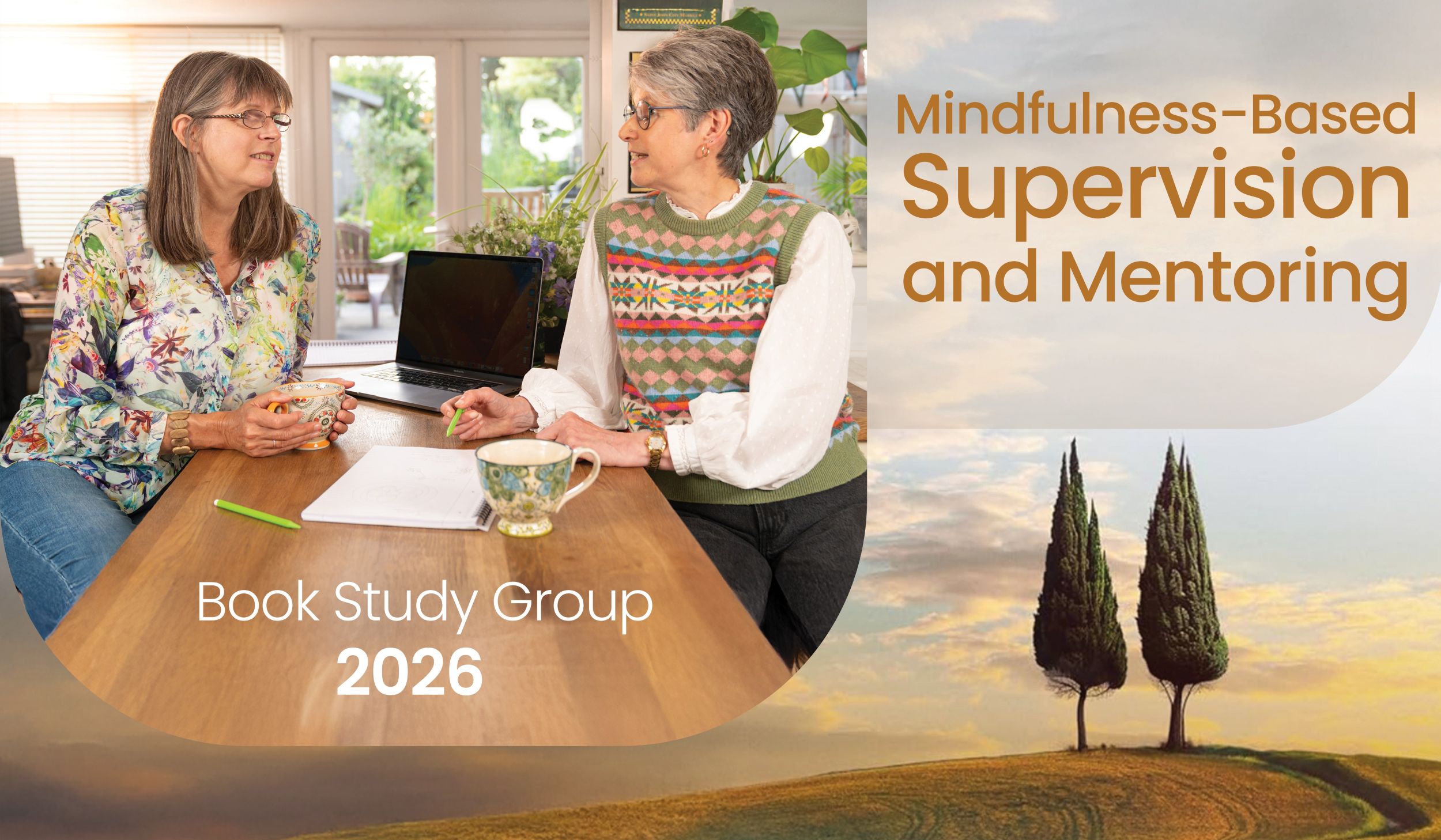
It’s nearly one year since completing the first draft of our now published book, Mindfulness-Based Supervision and Mentoring: Using an Embodied Dialogue to Support Learning and Reflection.
It feels like a great time to revisit in the company of other supervisors/mentors through our book study group. We, too, are reading and reflecting, using the book as a vehicle for further reflection and exploration. It’s a new year, and we both have a new supervision-based journal. We find we are reflecting through two lenses:
- as practitioners (i.e mindfulness-based supervisors/supervisees)
- as authors – seeing how the book lands with practitioners, where the gaps are, and seeing future directions being informed and shaped
We have invited participants in the book study group to use the framework of Connect, Extend, and Challenge as they read and reflect. This model, originating from Harvard University’s Graduate School of Education, encourages deeper learning:
- What do you connect with/resonate with?
- What extends your learning in new directions?
- What do you find challenging, uncertain, or have questions about?
In the first session, we explored three areas, drawing on the Introduction and Welcome, as well as Chapters 1 and 2. In this series of blogs, we highlight a small selection of our own learnings from the study, reflections and our conversations together. From this first session, we discovered:
Intention
In looking at our relationship to supervision, as practitioners, we also found ourselves pondering our outward-facing work in relation to mindfulness-based supervision (MBS). In many ways, we see ourselves as custodians of this work and wish to continue to offer further to the field. In our conversation, we identified three key areas shaping our developing vision for MBS: ACCESSIBILITY, EVOLUTION, LEARNING, and DEVELOPMENT. We will say more in future blogs and newsletters about our direction of travel.
The MBS Framework
We discovered we are quite familiar with considering the framework from our perspective of being in the supervisory role, but it was new to look at it as a supervisee. Both of us saw our tendency to bring the Petals, i.e., the content, to our supervision. We also saw how a short practice at the beginning of the supervision, and the supervisor holding the container, invited us to connect more with the warp of MBS, such as Embodied Presence, Compassion/Wisdom and Space.
The Theory Informing MBS
The reflections helped us identify areas of theory we want to learn more about and ponder on, e.g., social models, social ways of learning, and cultural influences. The process of reading, reflecting on one’s own experience, and then engaging in dialogue with another brings the theory to life and inspires curiosity to follow up. As group members named other theories that they draw on in their MBS work, it sparked an image of an optician’s glasses, where they have you try out different lenses to see how this affects what you see; we might see a particular theory as like one of these lenses. What do we “see” around MBS when we view it through a particular theoretical lens? What aspects are highlighted when we look at it this way?
By Alison Evans and Pamela Duckerin
To see how our vision unfolds and keep in touch with our work around mindfulness-based supervision/mentoring:
Sign up for the latest news: https://www.vividmindfulness.co.uk/ scroll to the orange section and enter your email
Check out our websites/make contact: https://www.vividmindfulness.co.uk/; https://www.pameladuckerin.com/
Read the book: Mindfulness-Based Supervision and Mentoring: Using an Embodied Dialogue to Support Learning and Reflection